

Introduction
Artificial intelligence has traditionally been built around the cloud. For years, organizations have relied on centralized infrastructure to process data, run machine learning models, and deliver intelligent experiences back to devices. This made sense when the workloads were batch-oriented and the interactions were asynchronous.
But real-time AI breaks that assumption entirely.
When a user expects a response in under two seconds, not from a search query, but from a live interaction with a photorealistic avatar, a voice interface, or a video stream, the cloud round-trip stops being an inconvenience and starts being a fundamental architectural problem. You can’t optimize your way out of physics. Network/Cloud inference has a floor, and for a growing class of applications, that floor is too high.
This is the core reason organizations are rethinking where AI should run.
What is Edge AI? An Introduction to On-Device Intelligence
How Cloud AI Works
Cloud AI relies on a centralized infrastructure for processing. In this model, a device captures data (such as video, audio, text or sensor input) and sends it across a network to a remote server. The cloud system processes the data using AI models and then returns a result back to the device.
This architecture has several advantages. Cloud environments provide access to large-scale compute resources, making it possible to run extremely complex models without being constrained by local hardware limitations. Cloud systems also simplify updates and centralized management since models can be maintained in a single location.
For applications involving large-scale analytics or non-real-time workloads, this approach can be highly effective. Tasks like recommendation systems, historical data analysis, and large language model processing often benefit from cloud infrastructure because they prioritize scale over immediacy.
However, cloud AI also introduces challenges that become more significant in real-time environments.
The Limitations of Cloud AI
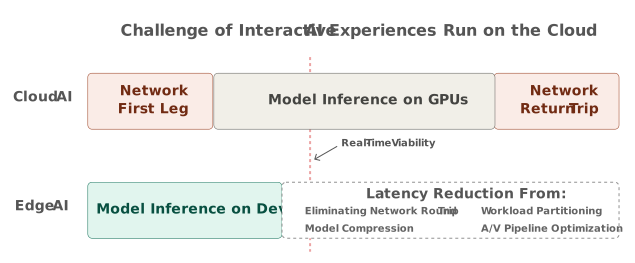
One of the biggest limitations of cloud AI is latency. Every interaction requires data to travel to a remote server and back again. Even on fast networks, this introduces delays that can negatively impact user experience.
To make this concrete: a real-time video avatar that responds to live speech needs to complete its entire pipeline — audio capture, language processing, speech synthesis, and video frame generation — in under 1-2 seconds to feel natural. If even 300-400ms of that budget is consumed by a cloud round-trip, the experience degrades noticeably. And that’s assuming a stable, low-latency connection. In practice, network conditions vary, and that variability makes the experience unpredictable in a way that users find more disruptive than consistent slowness.
Running model inference directly on the device eliminates the network round-trip entirely, recovering a substantial portion of the latency budget. For real-time interactive experiences involving synchronized audio and video, that single architectural shift moves the needle from infeasible to possible.
To effectively run it on device you need to find ways to run the model with constrained resources (storage, memory, processing, etc.). This effectively comes from three engineering disciplines applied to the on-device pipeline: workload partitioning across the device’s NPU, GPU, and CPU; model compression through quantization and distillation; and A/V pipeline optimization across decoding, noise reduction, and artifact removal. Applied together, they are what make sustained real-time performance achievable at the edge.
Bandwidth usage is another challenge. Applications that continuously stream video or sensor data to the cloud can become expensive to operate at scale. As video resolutions and frame rates increase, transmitting raw data becomes increasingly inefficient.
Privacy is also a growing concern. Many AI applications process sensitive data, including personal video, voice interactions, or behavioral information. Sending this data externally may introduce regulatory and security complications, particularly in industries with strict compliance requirements.
Finally, cloud AI depends heavily on connectivity. If a network connection is unstable or unavailable, system functionality may degrade or stop entirely. For devices operating in remote or mobile environments, this dependency can become a major limitation.
How Edge AI Changes the Architecture
Edge AI approaches the problem differently by moving inference directly onto the device itself.
Instead of transmitting data to a centralized server, the device processes information locally and generates outputs immediately. This eliminates the need for round-trip communication and allows systems to respond in real time.
The architectural shift may seem straightforward, but its impact is significant. Processing data at the edge fundamentally changes the responsiveness, efficiency, security, and reliability of AI-powered systems.
For example, a real-time video application running locally can react instantly to user input without waiting for a cloud response. This creates a smoother and more natural interaction experience.
Because data remains on-device, Edge AI also improves privacy and reduces bandwidth consumption. Devices become more self-sufficient and less dependent on external infrastructure. This reduction can greatly lower the server and data costs, while improving performance.
Where Edge AI Performs Best
Edge AI is especially valuable in applications where timing and responsiveness are critical.
A few examples include:
- Interactive AI systems: Applications involving live interaction, such as conversational interfaces or real-time video experiences require the entire inference pipeline to complete locally, within a budget of milliseconds per frame. That level of responsiveness is simply not achievable with a cloud dependency in the loop — not because the models are too large, but because the interaction itself demands immediacy that network round-trips cannot guarantee.
- Computer vision and video processing: Streaming high-resolution video to the cloud is both bandwidth-intensive and latency-sensitive. Running AI locally allows systems to analyze video streams instantly while reducing network overhead.
- Industrial and embedded systems: Devices operating in factories, vehicles, or remote locations often cannot rely on stable connectivity. Edge AI enables these systems to continue functioning independently in real-world conditions.
These use cases highlight why Edge AI is becoming increasingly important as AI moves into more dynamic and real-time environments.
The Role of Hardware Advancements
One reason Edge AI has become more practical in recent years is the rapid improvement in hardware acceleration.
Modern devices increasingly include specialized processors, called NPUs, designed specifically for AI workloads. These components allow devices to run sophisticated models efficiently while operating within power and thermal constraints.
Instead of relying entirely on CPUs, edge devices can now leverage hardware accelerators optimized for inference. This significantly improves performance and enables more advanced workloads to run locally. This can be done by managing the workload across not only the CPU and NPU but leveraging the GPU as well. By optimizing across the entire spectrum of processors available on the boards, larger models can be moved to the edge.
As hardware capabilities continue to improve, the range of applications that can run on-device will continue expanding.
Is Cloud AI Still Important?
Despite the advantages of Edge AI, cloud infrastructure still plays an essential role in the broader AI ecosystem.
Training large models typically requires substantial compute resources that are best handled in centralized environments. Cloud systems are also valuable for aggregating data, coordinating updates, and supporting large-scale orchestration.
In many cases, the most effective architecture is hybrid. Inference and real-time decision-making happen locally at the edge, while the cloud handles training, synchronization, and long-term analytics. This approach combines the responsiveness of Edge AI with the scalability of cloud infrastructure.

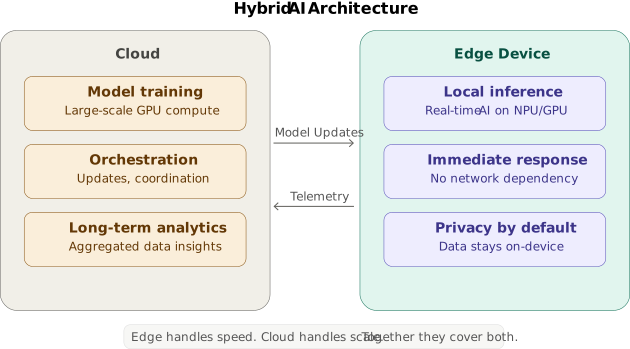
Rather than replacing the cloud entirely, Edge AI changes how responsibilities are distributed across the system.
Choosing the Right Architecture
Determining whether Edge AI or cloud AI is the better fit depends largely on application requirements.
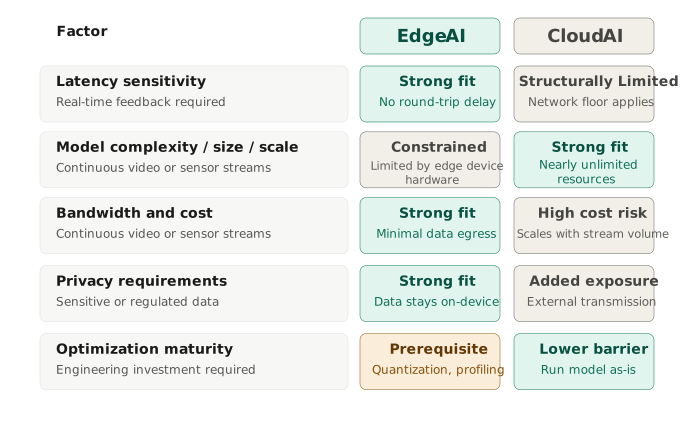
Applications focused on scalability, centralized processing, or large-scale analytics may benefit more from cloud infrastructure. On the other hand, systems that require low latency, local responsiveness, privacy, or offline operation are often better suited for edge deployment.
A few factors which organizations should evaluate include:
- Latency sensitivity: Applications requiring immediate feedback benefit significantly from local inference because they eliminate network delays and create more responsive experiences.
- Bandwidth and operational cost: Systems processing continuous streams of video or sensor data can reduce cloud costs substantially by minimizing data transmission.
- Privacy requirements: Applications involving sensitive or regulated data may benefit from local processing because it reduces exposure and simplifies compliance.
- Model optimization maturity: Edge deployment is not just a infrastructure choice, it requires investment in model optimization. The same model that runs on a cloud GPU will not simply transfer to an edge NPU without significant engineering work. Organizations should factor in whether they have the expertise, or the right partners, to close that gap efficiently.

The best solution is rarely one-size-fits-all. The architecture should align with the technical and operational demands of the product itself.
Conclusion
The debate between Edge AI and cloud AI is not about which technology is universally better. Instead, it is about choosing the right architecture for the right workload.
Cloud AI remains essential for training, orchestration, and large-scale processing. But as applications become increasingly interactive and real-time, Edge AI is emerging as the preferred solution for delivering fast, responsive, and reliable experiences.
By moving intelligence closer to where data is created, Edge AI enables a new generation of applications that are more efficient, private, and capable of operating independently of centralized infrastructure.
The organizations best positioned for this shift are not necessarily those with the largest cloud footprints, they are the ones that understand how to optimize AI for the hardware it actually runs on. That requires a different kind of expertise than cloud AI: one focused on efficiency, latency budgets, and the practical realities of deploying intelligence onto constrained devices. As that expertise becomes a competitive differentiator, the ability to move fast at the edge will matter as much as the quality of the models themselves.