
Introduction
Artificial intelligence has traditionally been built on top of centralized cloud infrastructure. Data is collected on devices, sent to remote servers for processing, and then returned with a result. For years, this model has powered everything from recommendation systems to image recognition.
But a fundamental shift is underway, and it is happening faster than most people expected.
When we set out to run a real-time AI avatar engine on a mid-tier edge processor, the received wisdom was that this class of hardware simply wasn’t capable of it. Flagship smartphones, possibly. Dedicated cloud GPUs, certainly. But a mainstream consumer electronics chip? The assumption was that you’d need to make too many compromises on quality to make it work.
We proved that assumption was wrong, and what we learned in the process reshaped how we think about Edge AI entirely. The hardware is often thought of as the primary bottleneck, but it’s almost always the approach to optimization.
As applications demand faster responses, stronger privacy guarantees, and more reliable performance, AI is increasingly moving onto the devices where data is created. This is Edge AI, and it represents a fundamental change not just in where computation happens, but in how intelligent systems are designed from the ground up.
What is Edge AI?
Edge AI refers to running artificial intelligence models directly on local hardware, including smartphones, cameras, embedded systems, and other connected devices, rather than sending data to centralized cloud infrastructure.
At a high level, Edge AI combines two ideas. The first is edge computing, which focuses on processing data close to where it is generated. The second is artificial intelligence, which allows systems to interpret and act on that data. When these are brought together, the result is a system that can make decisions instantly, without depending on external resources.
In practical terms, this means a device can capture data, process it, and generate an output all within its own environment. There is no need to wait for a server response or depend on network conditions. The system becomes self-contained, responsive, and significantly more efficient for certain types of applications.
You Can’t Optimize Your Way Out of Physics: The Case for Edge AI in Real-World Applications
How Edge AI Differs from Cloud AI
To understand why Edge AI is gaining traction, it’s helpful to compare it with the traditional cloud-based approach.
In a cloud AI system, data must travel from the device to a remote server, be processed, and then returned. This introduces unavoidable delays and creates dependencies on network quality. While this model is effective for large-scale processing and centralized analytics, it can struggle in situations where timing is critical.
Edge AI removes this dependency by keeping computation local. Instead of sending data across a network, the device processes it immediately. This eliminates round-trip latency and makes the system more predictable and secure.

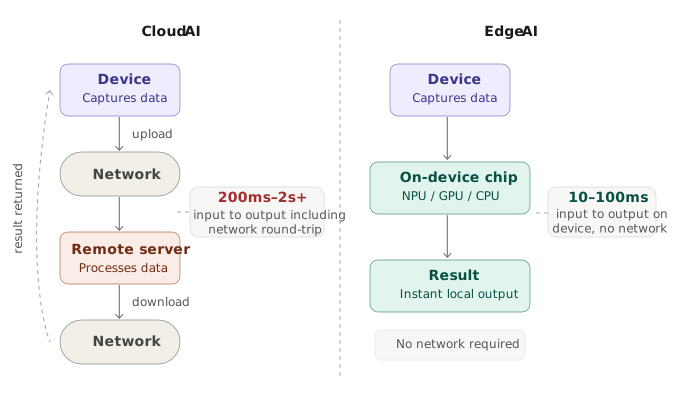
The difference becomes especially important in real-time applications. Even small delays, on the order of a few hundred milliseconds, can disrupt user experiences in interactive systems. By processing data on-device, Edge AI ensures that responses feel instantaneous and natural.
Why Edge AI Is Growing: Benefits Driving Adoption
Edge AI’s growth is not a coincidence of timing. The same properties that make it technically distinctive (speed, privacy, efficiency, and resilience) are the ones that matter most to the applications being built today. Each benefit directly addresses a real constraint, and together they are reshaping where and how AI gets deployed.
The core benefits, and the drivers of adoption, are the same thing:
- Real-time responsiveness: Modern applications increasingly require immediate feedback, and even a few hundred milliseconds of delay can break an interactive experience. Edge AI eliminates network round-trips entirely, enabling responses that feel instantaneous whether the application is video, voice, or live analytics.
- Privacy and data control: As AI systems handle more sensitive data, on-device processing reduces exposure by keeping data local, with no transmission to external servers. This simplifies compliance, reduces breach surface area, and builds user trust in a way that cloud-dependent architectures cannot easily replicate.
- Cost and bandwidth efficiency: Sending continuous data streams, especially video, to the cloud is expensive at scale. Edge AI reduces bandwidth consumption and cloud compute spend while also enabling scalability through distribution: intelligence runs on the devices themselves, removing centralized bottlenecks as user numbers grow.
- Reliability in real-world environments: Devices operating in remote, mobile, or industrial settings cannot rely on stable network access. By processing locally, Edge AI keeps systems functional regardless of connectivity, making it the only viable architecture for many real-world deployment environments.
- Advances in hardware acceleration: Modern devices are increasingly equipped with specialized NPUs (Neural Processing Units) designed for AI workloads, enabling efficient on-device inference within tight power, thermal, and memory bandwidth constraints.
How Edge AI Works
Although the concept of Edge AI is straightforward, the process of deploying AI models to devices involves several complex steps. Each step plays a role in ensuring that models run efficiently within the constraints of edge hardware.

The lifecycle typically includes:
- Model training: AI models are first trained using large datasets, usually in cloud environments where significant compute resources are available. This stage focuses on achieving high accuracy and learning patterns from data.
- Model optimization: Once trained, models must be adapted for edge deployment, and this is where the real engineering begins. Techniques like quantization, pruning, operator fusion, and workload partitioning interact in ways that aren’t always intuitive — reducing a model from 32-bit to 8-bit precision, for example, doesn’t just cut memory usage, it can actually improve output quality. The right combination depends entirely on the application and target hardware, making optimization expertise the deciding factor in whether an edge deployment succeeds.
- Deployment to hardware: After optimization, models are packaged and deployed onto specific devices. This step often requires aligning with the capabilities of the hardware, including supported runtimes and accelerators.
- On-device inference: The final stage is where Edge AI delivers its value. The model runs locally on the device, processing incoming data and generating outputs in real time. This eliminates the need for external communication and enables immediate responses.
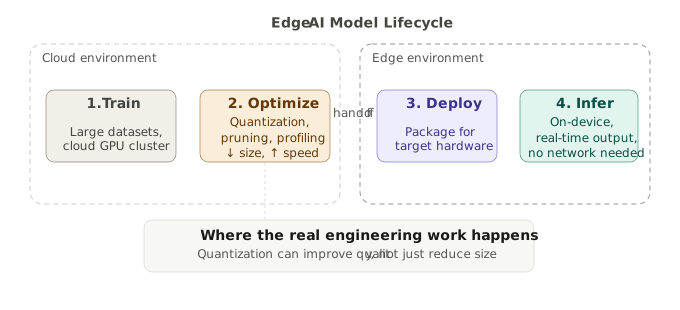
Each of these stages requires careful consideration, particularly when working across different types of hardware with varying capabilities. Choosing the wrong combination, or over-optimizing, can lead to degradation of the quality and overall experience.
Challenges of Edge AI
Despite its advantages, Edge AI introduces its own set of challenges. Understanding these is important, not to be discouraged by them, but because underestimating them is the most common reason edge deployments underperform.
Workload partitioning is harder than it looks: The difference between a model that runs at 40ms per frame and one that runs at 400ms on the same chip rarely comes down to the model itself. It comes down to how computation is distributed – which operations run on the NPU, which on the CPU, and how data flows between them without creating bottlenecks. Getting this wrong doesn’t just hurt performance; it can make a real-time application feel broken.
Fragmentation across hardware: Edge AI must run across a wide range of platforms, including Qualcomm, MediaTek, Intel, AMD, NVIDIA Jetson, Rockchip, Raspberry Pi, and embedded SoCs, each with different chipsets, runtimes, and optimization toolkits. A model tuned for one NPU architecture won’t transfer to another, so scaling across devices demands either significant per-platform engineering or an abstraction strategy that doesn’t sacrifice performance.
Optimization requires genuine expertise: Quantization, pruning, and architecture redesign are not plug-and-play processes. Each decision involves tradeoffs between accuracy, latency, memory, and power. The right balance depends heavily on the specific application. A model optimized for always-on keyword detection has very different constraints from one generating real-time video. There is no universal recipe.
These challenges are real, but they are well-understood by teams with deep experience in the space. And they point to something important: while edge hardware is becoming increasingly capable, the real differentiator is no longer just the silicon.
It is the software stack, optimization expertise, deployment pipeline, and system engineering required to achieve production-quality performance. The hardware sets the ceiling. The engineering determines how close you get to it.
Real-World Use Cases of Edge AI
Edge AI is already being applied across a wide range of domains, and the most instructive examples tend to be the ones where the real-time constraint is non-negotiable.
In smart devices, Edge AI enables features like object detection and voice recognition without relying on cloud services. In industrial environments, it supports automation and monitoring systems that must operate reliably in disconnected settings. In consumer applications, it powers increasingly interactive and responsive experiences.
One of the most compelling areas of growth is real-time video AI. Processing video streams locally allows systems to analyze and respond instantly, which is critical for applications such as interactive interfaces and live feedback systems.
What these use cases share is that the value of Edge AI compounds: lower latency makes the experience better, lower cost makes it scalable, and on-device processing makes it compliant. The three reinforce each other.
The Shift Toward Edge-First AI
As expectations for AI systems continue to evolve, the industry is moving toward an edge-first mindset. Rather than treating the cloud as the default location for computation, developers are increasingly designing systems that prioritize local processing.
In this model, the cloud still plays an important role in training models, retrieving real-time information, aggregating data, and coordinating updates. However, the actual inference (the moment where data is turned into action) happens at the edge.
This hybrid approach combines the strengths of both environments while minimizing their limitations. It reflects a broader trend toward distributing intelligence across the entire system rather than centralizing it in one place.
Conclusion
Edge AI represents a fundamental shift in how artificial intelligence is delivered. By moving computation closer to where data is generated, it enables faster, more private, and more reliable systems.
As hardware continues to improve and real-time applications become more common, this approach is becoming increasingly important. Organizations that understand how to design and deploy Edge AI systems will be better positioned to build the next generation of intelligent products.
Some of the most demanding real-time applications being built today are edge-first by necessity, not by choice. Real-time video avatars are a clear example: achieving natural, responsive lip-sync on a device with a fraction of the cloud’s compute requires solving hard optimization problems that simply don’t exist in a cloud deployment.
The teams doing this work aren’t just building features, they’re developing a new engineering discipline. That discipline is what Edge AI, at its best, looks like in practice.