

Introduction
Imagine preparing for a first date or a job interview with a digital avatar coach. Every reply takes four to five seconds. You share something personal and get silence, then a response that feels disconnected from the moment. The rhythm that makes conversation feel genuine is gone. Practicing in that environment does not prepare you for the real thing.
Now imagine the same conversation with a one-second delay. The avatar reacts to your tone, follows your train of thought, and feels present. You start to forget you are talking to an AI. That is the difference Edge AI can make. It turns a practice tool into something that builds real confidence.
The gap between those two experiences is latency, the delay between an input and its response. In AI systems, that delay can come from network communication, model processing, hardware limits, or inefficient software pipelines. Latency is one of the most important performance factors in artificial human experiences, where an AI system looks, sounds, and responds like a person in real time. Outside engineering teams, it is often misunderstood.
What is Edge AI? A Complete Guide to On-Device Intelligence
How Latency Impacts Artificial Human Experience
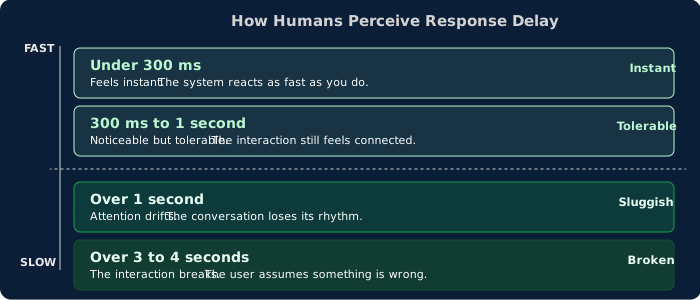
Humans are highly sensitive to timing. Whether we are talking to a voice assistant, a real-time avatar, or a live AI application, we expect responses to feel immediate. Even small delays matter.
Latency affects more than convenience. It shapes trust and usability. Systems that respond instantly feel intelligent and polished. Systems that lag can seem unreliable, even when the underlying model is highly accurate.
Video raises the stakes. Any mismatch between speech, motion, and visuals is immediately noticeable. That makes reducing latency without sacrificing realism one of the hardest challenges in bringing interactive applications to the edge.
Why Real-Time Applications Are Especially Sensitive
Not all AI applications are equally affected by latency. Some workloads, such as historical analytics or offline processing, can tolerate delays without affecting the user experience.
Real-time systems are different.
Applications involving live interaction require continuous responsiveness. This includes experiences like:
- Interactive AI interfaces
- Real-time audio or video processing
- Live computer vision systems
These systems rely on immediate feedback loops. Delays disrupt synchronization and reduce immersion.
This is one reason why many real-time AI systems are moving toward edge-first architectures.
Where Latency Comes From
Latency in AI systems usually comes from four major sources: the network, the model, the hardware, and the software pipelines around them.
The network is often the largest contributor. In cloud-based systems, data must travel to a remote server for processing and then return to the device. Even fast internet connections introduce unavoidable delays.
The model complexity is the next. Larger AI models often require more computation time, especially if hardware acceleration is limited. If a model is not optimized correctly, inference can become too slow for real-time interaction.
The hardware sets the ceiling. Even in the cloud, differing GPU tiers produce different latencies. Devices or servers with insufficient processing capabilities may struggle to keep up with demanding workloads, leading to slower response times and inconsistent performance.
Finally, the software pipeline ties the other three together. Poorly optimized pipelines, unnecessary processing steps, or inefficient scheduling can all increase latency leading to poor artificial human experiences.

These sources compound dramatically once you move beyond text. A text response is a few kilobytes; a real-time video experience means capturing audio, running inference, generating speech, and rendering synchronized video — many times per second. Every one of the four sources above is multiplied by that frame rate. This is why an approach that works acceptably for a text chatbot can fall apart completely for a real-time avatar: the latency budget that felt generous for text becomes punishing when every frame has to arrive on time.
How Edge AI Reduces Latency
Edge AI minimizes latency by eliminating the need to send data across networks for processing.
Instead of relying on a remote server, the device itself performs inference locally. This removes the round-trip communication delay that is common in cloud-based systems.
The impact is substantial. Processing happens immediately, creating smoother and more responsive interactions.
Local inference also makes system behavior more predictable because performance is no longer dependent on network conditions. This consistency is especially important in environments where connectivity may fluctuate.
Strategies for Reducing AI Latency
Improving latency requires optimizing multiple parts of the system simultaneously.
A few important approaches include:
- Model optimization: Smaller and more efficient models generally process data faster. Techniques such as quantization and pruning reduce computational requirements while maintaining acceptable accuracy.
- Hardware acceleration: Specialized processors like NPUs and GPUs significantly improve inference speed by handling AI workloads more efficiently than general-purpose CPUs.
- Efficient pipelines: Reducing unnecessary processing steps and optimizing data flow can dramatically improve responsiveness, particularly in video applications.
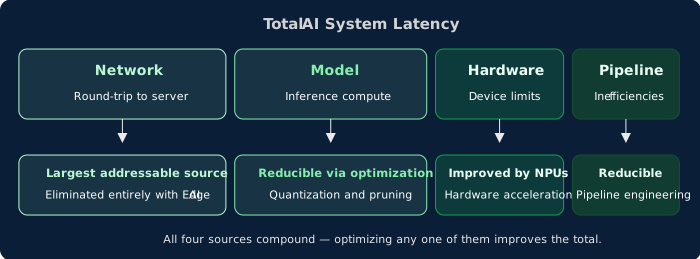
Latency optimization is not a single adjustment — it is an ongoing engineering discipline focused on balancing performance, efficiency, and responsiveness.
Conclusion
Latency is far more than a technical metric. It directly shapes how users perceive AI-powered systems and determines whether experiences feel natural, responsive, and trustworthy.
As AI continues moving into real-time applications, minimizing latency is becoming increasingly critical. This is one of the primary reasons Edge AI is gaining momentum across industries.
By processing data locally and reducing dependency on cloud communication, Edge AI enables the low-latency performance required for the next generation of intelligent experiences.
This is the problem we work on at Ittiam. Building applications like real-time video avatars that run entirely on-device means treating latency not as a number to improve, but as the difference between an experience that feels human and one that doesn’t. When every frame has to arrive in under a fraction of a second, on hardware that fits in your pocket, latency stops being an engineering detail and becomes the entire product.